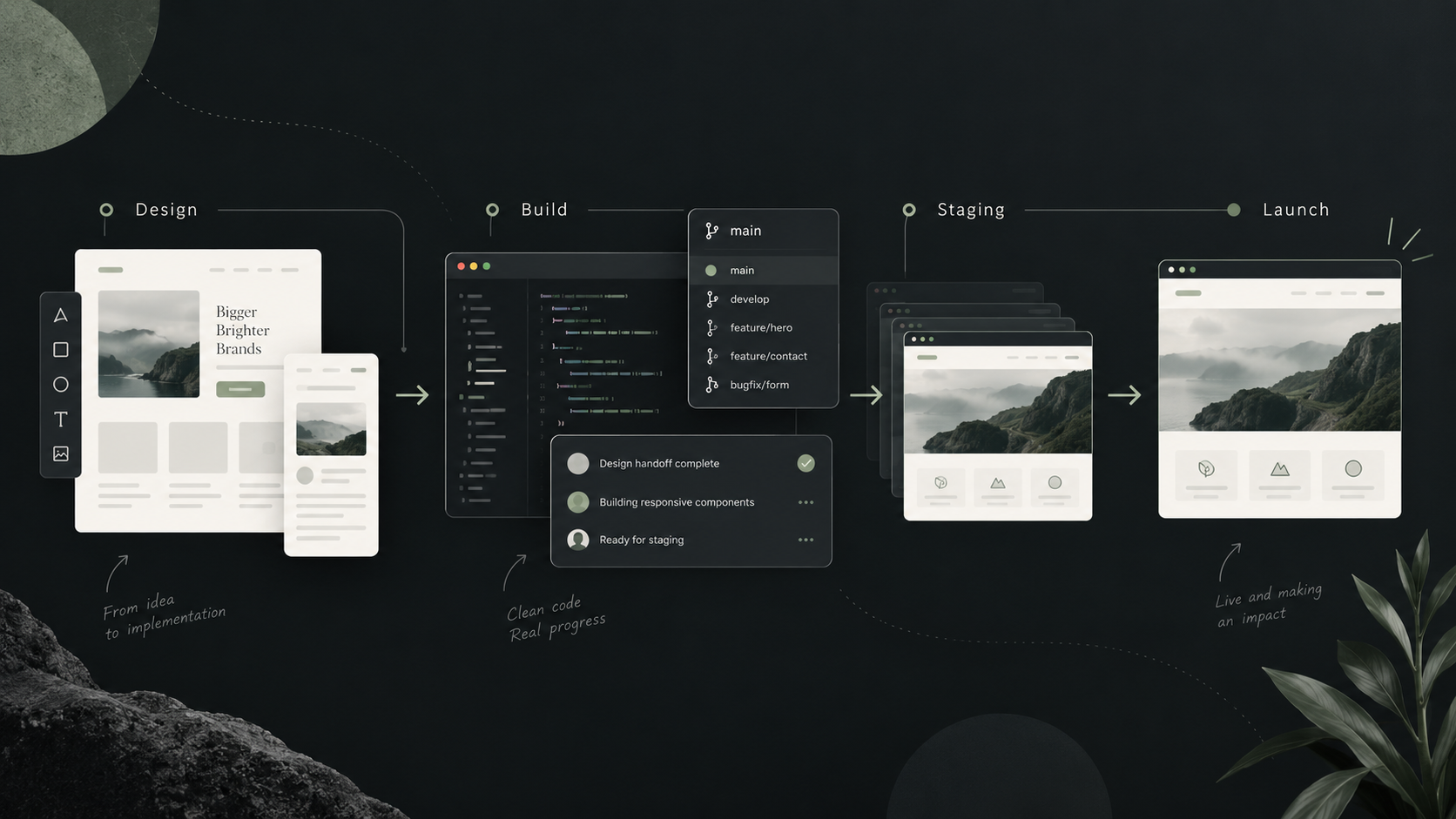
Agency workloads are rarely consistent.
One month the development team has plenty of capacity. The next, two projects have been signed off at once, an existing client needs something urgently, and a developer is already committed elsewhere.
Hiring another permanent developer isn’t always the answer. For digital and creative agencies, working with a freelance web developer can provide extra capacity when it’s needed without adding another permanent role to the team.
I’ve worked both within agency teams and alongside them as a freelancer, primarily delivering WordPress and Laravel projects. The arrangements that work best aren’t really about “outsourcing” development. They’re about bringing in someone who can fit into the way the agency already works and take responsibility for a piece of delivery without creating another layer of management.
When does bringing in a freelance developer make sense?
There are a few situations I see regularly.
Your development team is at capacity
Sometimes there simply aren’t enough development hours available. Perhaps several projects have reached development at the same time, an existing client has requested additional work, or a deadline has moved forward.
A freelancer can provide temporary capacity without an agency needing to recruit around a short-term spike in workload. That might mean taking ownership of an entire WordPress build, developing part of a larger project, or picking up smaller pieces of work that are preventing the internal team from concentrating on something more important.
You need a skill you don’t have in-house
Not every agency needs every technical specialism permanently available.
An agency might have an excellent front-end team but occasionally need someone comfortable building bespoke WordPress functionality. Another might primarily produce marketing websites but occasionally win a project that needs a Laravel application, API integration or more complicated back-end development.
A design-led creative agency might not have developers in-house at all, and need someone who can turn their visuals into a working site.
Bringing in a specialist for those projects can make more sense than trying to build permanent capacity around work that only appears occasionally.
There’s a gap in the team
Recruitment takes time. If a developer leaves, takes extended leave or an agency is between hires, existing client work still needs to be delivered.
A freelancer who can work within the agency’s existing processes can provide useful continuity while the permanent team is being rebuilt.
You’ve won a project that’s larger than usual
Winning a bigger project should be a good problem. It becomes less good if accepting it means placing the rest of the agency’s client work under strain.
Additional freelance capacity gives an agency the option of taking on projects that might otherwise stretch the internal team too far.
What can a freelance developer actually take on?
This depends on the agency and the project, but I tend to work with agencies in a few different ways.
Complete WordPress builds
An agency supplies the approved designs and project requirements and I handle the development through to staging and launch.
That can include bespoke theme development, custom fields and content management, third-party integrations, performance work and deployment. The agency remains the client’s main point of contact while I work as part of the delivery team.
Some of the agencies I work with are creative agencies whose focus is primarily on design. They produce the visuals and I turn them into working WordPress sites. They’ll also keep me in the loop while the designs are being developed, so they know everything they’re presenting to their client can actually be built.
More about WordPress development
Laravel development
For agencies taking on more technically involved projects, I can work on Laravel applications, portals, dashboards, integrations and existing Laravel codebases.
That could mean taking responsibility for a complete application or joining an existing development team for a particular piece of functionality.
More about Laravel development
Existing and inherited projects
New builds aren’t the only reason agencies need outside help. Sometimes an existing client arrives with a WordPress site that has become difficult to maintain, or an agency inherits a project built by another developer.
Before making changes, I prefer to understand what’s already there: the hosting environment, repository, dependencies, plugins, custom code and deployment process. From there, we can make a sensible decision about whether the project needs incremental improvement, refactoring or something more substantial.
Smaller ongoing development work
Not every agency needs another developer for a full project. There may simply be a backlog of client requests, integrations, bug fixes and improvements that the core development team never quite has time to reach.
That kind of ongoing overflow work can also work well on a freelance basis.
White-label development: your agency stays front and centre
When I’m working on behalf of another agency, I’m happy to operate white-label. The agency keeps the client relationship, and from the client’s point of view the work is delivered by your agency.
I can work under your brand, sign an NDA where required and use the systems your team already uses. I can stay entirely out of view or speak to the client directly as part of your team, whichever suits you.
Read more about white-label development
A freelancer shouldn’t create more work for your team
One of the biggest concerns when bringing another developer into a project is management overhead.
Extra capacity isn’t particularly useful if an internal developer has to spend half their week explaining what needs doing, checking everything afterwards and chasing for updates. That’s where agency experience matters.
I’m used to working from briefs and supplied designs, using Git-based workflows, working against staging environments and keeping project managers updated without needing constant supervision.
If your agency already uses GitHub, ClickUp, Jira, Slack, Teams or another project-management setup, the easiest approach is usually for me to join that rather than introduce another process.
The goal is to reduce pressure on the existing team, not move it somewhere else.
Communication matters as much as the development
Technical ability is important, but agency work adds another requirement: reliability. If you’ve promised something to your client, you need to know whether development is on track.
That means raising questions early rather than discovering a problem the day before launch. It means being clear when something is outside the original scope. And if a technical decision has consequences for budget or timings, the agency needs to know before that decision is made.
I try to keep communication straightforward. If something is going well, you’ll know. If something is going to cause a problem, you’ll know that too.
What about handover?
Freelance development shouldn’t leave an agency dependent on the freelancer forever.
Code should live somewhere the agency controls, normally in its own repository, and the project should be understandable by another competent developer. Where documentation is useful, it should be provided.
The same goes for hosting, credentials and third-party accounts. Wherever practical, those should belong to either the agency or the end client rather than becoming tied to a developer’s personal accounts.
That makes the project easier to maintain whether I continue working on it or somebody else picks it up later.
Fixed price, day rate or retainer?
All three can work, depending on the type of work.
For a clearly defined website build with signed-off designs and requirements, a fixed project cost may make sense.
For inherited codebases or situations where the requirements are likely to change, working on a day rate is often more practical.
For agencies with a steady flow of smaller client requests, a retainer can work well: an agreed number of days each month, reserved in advance, so there’s always development time available without needing to book it project by project.
The important part is agreeing how the work will be handled before development starts, so the agency knows what it can confidently quote or commit to its client.
Freelance development doesn’t have to mean one-off development
Some agency relationships start because of one unusually busy month. The more useful ones often become longer term.
Once I’ve worked with an agency for a while, I already understand how its projects are structured, how designs are supplied, how its repositories are organised and what its expectations are around testing, communication and handover. That makes it much easier to bring me back in when capacity is tight.
There’s no need for the agency to guarantee a permanent stream of work, and there’s far less onboarding each time something new comes along.
What should an agency look for in a freelance developer?
I’d look beyond the technology list. WordPress or Laravel experience is important, but I’d also want to know:
- Have they worked with agencies before?
- Can they work from another team’s designs and processes?
- Are they comfortable using version control and staging environments?
- Who owns the code when the project is finished?
- Can they communicate directly with clients if required?
- Are they comfortable signing an NDA?
- How do they handle changes in scope?
- What happens if they identify a problem during development?
- Can they support the work after launch?
- Will another developer be able to take over the project later?
Those questions tell you quite a lot about whether somebody will actually make an agency’s life easier.
Need additional development capacity?
I’m a UK-based freelance web developer with more than 15 years’ experience, specialising in WordPress and Laravel development.
I work directly with businesses, but I also work with digital and creative agencies that need additional development capacity. That might be an entire build, specialist help on a particular project or ongoing overflow work.
I can work white-label and fit into your existing workflow. You can read more about how I work with agencies, or if your team has a project coming up or you’re looking for a developer you can call on when things get busy, tell me what you’re working on.